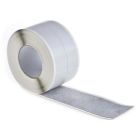

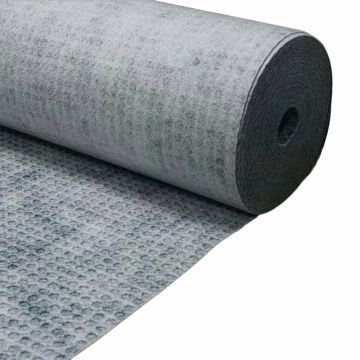
Newton DampSafe 603 Tile D-Mat Decoupling Membrane – 1m x 30m
3mm decoupling membrane for tiled floors that isolates movement, relieves stress and protects finishes from cracking.
Decoupling Membrane for Floor Tiles
Newton DampSafe 603 Tile D-Mat is a high-performance 3mm decoupling membrane. It is designed to isolate tiled floor finishes from movement, cracking and stress within the substrate.
Used within tiled floor build-ups, the membrane forms a separation layer that prevents stresses from transferring into the finished surface. This helps to maintain the integrity and longevity of tiles, particularly in challenging or variable substrates.
How does the Newton decoupling membrane work?
The decoupling membrane creates a separation layer between the substrate and the tiled finish. This allows each to move independently without transferring stress. Effectively, the membrane absorbs the stresses, protecting the tiled finish.
The dimpled core forms a structured air gap beneath the membrane, helping to distribute loads and equalise vapour pressure. At the same time, the fleece layers provide strong mechanical adhesion above and below, ensuring the system remains stable while accommodating movement.
This combination allows compressive stresses, thermal expansion and minor substrate movement to be absorbed within the membrane rather than transferred to the tiled surface.
The dimpled polyethylene core creates a structured air gap beneath the membrane. This allows for vapour pressure equalisation while also improving load distribution across the tiled surface. Fleece layers bonded to both sides of the membrane provide excellent adhesion. This ensures a secure bond to both the substrate below and the tile adhesive above.
Uses
It's important to take steps to avoid tile failure. Substrate movement - whether from shrinkage, thermal expansion or minor structural deflection - is one of the most common causes of tile failure, and a decoupling membrane is an effective way of addressing this.
This makes Newton DampSafe 603 particularly suited to installations where movement risk is higher, such as:
- New screeds still undergoing shrinkage
- Timber or mixed substrates
- Floors incorporating underfloor heating systems
- Refurbishment projects with variable substrates
When joints are sealed, the membrane can also act as an effective vapour control layer, helping to manage moisture within the floor build-up.
Benefits
- Minimal build-up – at approximately 3mm thickness, the membrane adds very little to finished floor height.
- Excellent bond strength – fleece layers rapidly absorb adhesive for strong mechanical adhesion.
- Vapour pressure management – dimpled structure allows air movement beneath the membrane.
- Durable and load-bearing – suitable for tiled and paved floor finishes.
- Thermal efficiency – low thermal conductivity supports use with underfloor heating systems.
Installing a decoupling membrane
System build-up
Tiles / Floor Finish
↓
Tile Adhesive Layer
↓
Newton DampSafe 603 Tile D-Mat (decoupling membrane)
↓
Adhesive Bond to Substrate
↓
Substrate (concrete, screed or timber)
Preparation
Substrates must be structurally sound, clean, level and suitable for tiling. Screeds should be sufficiently dry (relative humidity (RH) of 75% or less) and all installations should follow relevant standards and adhesive manufacturer guidance.
When Not to Use a Decoupling Membrane
Decoupling membranes are designed to manage movement and stress, not to compensate for poor substrate condition or structural defects.
- Unsound or unstable substrates – substrates must be structurally sound and capable of supporting the finished floor.
- Excessively damp or contaminated surfaces – substrates must be clean, dry and free from materials that could inhibit adhesion.
- Unlevel floors requiring correction – levelling compounds should be applied prior to installation where required.
- Situations requiring full structural waterproofing – this product is not a substitute for a designed waterproofing system.
Correct preparation is essential to ensure long-term performance. Where there is uncertainty around substrate condition or system design, our technical team can advise on the most appropriate solution.
For preparation and installation guidance, explore our range of damp proof membranes or speak to our technical team for advice.
PermaSEAL - Complete Solutions. Made Possible.
At Permagard, we supply professional-grade waterproofing, damp proofing and flooring protection systems trusted by contractors and specifiers across the UK.
Our in-house technical team offers free expert advice to help you select the correct system for your project - from membrane selection through to full build-up specification.
If you would like to discuss your project, call us on 0117 982 3282.
Features
- Decouples tiles from substrate movement to prevent cracking.
- Only 3mm thick for minimal floor build-up.
- Dimpled design ventilates substrate and manages vapour pressure.
- Fleece-backed for strong adhesion to substrate and tiles.
- Suitable with underfloor heating systems.
- Durable and load-bearing for tiled and paved floors.